Choosing a Repair Shop Versus Roadside Technician
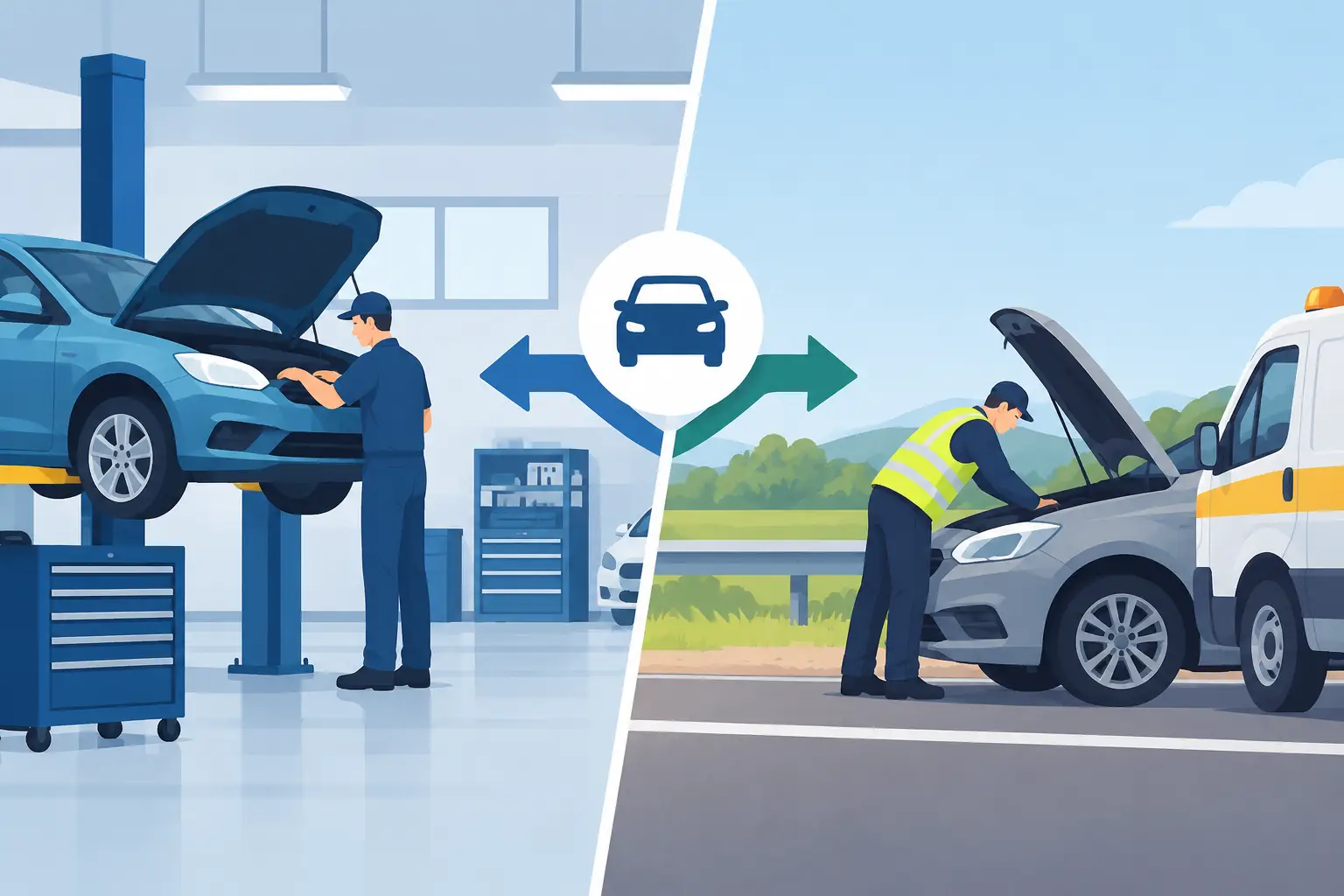
A stalled car does not give you the luxury of making a calm, researched decision. You may be on the shoulder of I-84, outside a grocery store with kids in the back seat, or stuck in your driveway before work. The repair shop versus roadside technician question comes down to one thing: can the problem be handled safely where you are, or does the vehicle need a full diagnosis and repair?
A good answer protects your time, your vehicle, and most importantly, your safety. Roadside help can get many drivers moving again within minutes. Other problems require a tow because attempting a quick fix at the roadside can make the situation worse or leave you stranded again a few miles later.
Repair Shop Versus Roadside Technician: The Basic Difference
A roadside technician comes to your location to address common no-start and minor breakdown situations. Their job is to assess the immediate issue, perform practical services that can be completed safely on-site, and help you avoid a tow when that is a realistic option.
A repair shop has the equipment, parts access, lifts, diagnostic tools, and controlled workspace needed for more involved mechanical work. Shops are where vehicles go when the cause is uncertain, the repair is too complex for the roadside, or the vehicle cannot be driven safely.
Neither option is automatically better. The right choice depends on the symptom, your location, the condition of the vehicle, and whether a roadside solution will truly hold up after the technician leaves.
When a roadside technician is usually the right call
Roadside service is often the fastest and least disruptive answer when the problem is straightforward. A dead battery is a familiar example. If the battery simply needs a jump-start and the vehicle starts and runs normally, you may be able to continue to work, get home, or drive to a shop for a battery test at a better time.
Other situations that may be handled on-site include a flat tire when you have a usable spare, an empty fuel tank, keys locked in the vehicle, or a minor issue preventing the car from starting. A trained technician can also look for obvious warning signs before advising you to drive away.
Roadside help is particularly valuable when a tow would create an unnecessary delay. If you are safely parked in Gresham or Troutdale and the vehicle only needs fuel or a jump, having someone come to you can turn a stressful interruption into a short stop.
Still, a roadside visit is not a promise that every issue can or should be repaired in a parking lot. A responsible technician will be honest when towing is the safer next step.
When towing to a repair shop makes more sense
Call for a tow when the vehicle has a problem that affects control, braking, steering, engine operation, or road safety. If the engine is overheating, smoke is coming from under the hood, fluids are leaking heavily, or warning lights are paired with rough running, do not assume you can drive a few more miles.
A tow is also the right choice after a collision, even when the damage looks minor. Bent suspension parts, damaged tires, loose body panels, or unseen fluid leaks may not be obvious from the driver's seat. Continuing to drive could cause more damage or create a hazard for you and other drivers.
Mechanical failures often need shop-level diagnosis as well. Grinding noises, a slipping transmission, repeated stalling, a failed alternator, a broken belt, or an engine that will not crank can all have multiple causes. A roadside technician may identify the likely issue, but a repair facility is usually needed to test components, source parts, and complete the repair correctly.
Ask These Questions Before You Decide
When you are stressed, it helps to use a short decision process. First, ask whether the vehicle is in a safe place. If you are in a traffic lane, on a narrow shoulder, near a blind curve, or in severe weather, prioritize getting yourself out of danger. Turn on hazard lights, move away from traffic if you can do so safely, and request assistance rather than working on the vehicle yourself.
Next, think about what happened immediately before the problem. Did the car run normally until you left the lights on and drained the battery? Did you see the fuel gauge on empty? Those clues point toward problems a roadside technician can often resolve.
On the other hand, did the vehicle make a loud pop, pull sharply to one side, lose power, overheat, or develop a burning smell? Those are signs that driving may not be safe. In that case, skip the gamble and arrange a tow to a repair shop.
Finally, consider what happens after the immediate service. A jump-start can get a car running, but a battery that repeatedly dies may need replacement. A spare tire gets you moving, but it is not meant for long-term driving at regular highway speeds. Roadside service handles the urgent moment; a shop handles the underlying repair when one is needed.
The Hidden Cost of Choosing the Wrong Option
Many drivers hesitate to request a tow because they want to save money or avoid losing time. That is understandable. But driving a damaged vehicle can turn a manageable repair into a major one.
For example, running an overheating engine can cause severe engine damage. Driving on a shredded tire can damage the wheel or suspension. Ignoring a charging-system problem after a jump-start can leave you stranded again, possibly in a less safe location. The lowest-cost choice is not always the safest or most affordable choice by the end of the day.
The opposite is true, too. Calling for a tow when you simply ran out of gas or left an interior light on may add expense and delay that roadside help could have avoided. The value of an experienced roadside technician is not only the service itself. It is getting a practical recommendation based on what your vehicle is doing right now.
What to Tell the Dispatcher
Clear details help the right truck and equipment arrive faster. Describe your location as precisely as possible, including nearby cross streets, landmarks, travel direction, or the parking lot entrance where you are waiting. Let the dispatcher know whether you are in a safe location or blocked in traffic.
Explain the vehicle type and the symptom. Mention if it is a car, pickup, motorcycle, trailer, or light truck, and share what you noticed: no crank, clicking noise, flat tire, empty fuel tank, overheating, accident damage, or keys inside the vehicle. If your vehicle sits low, has all-wheel drive, is carrying a trailer, or has unusual damage, say so before service is dispatched.
That information helps a local provider such as Tow Guys LLC prepare for the job rather than arriving with the wrong setup. It also helps the technician make a better call about roadside service versus towing before valuable time is lost.
A Roadside Fix Should Never Override Safety
There are times when a simple issue becomes a towing situation because of where it happens. A flat tire in a quiet driveway is different from a flat tire beside fast-moving traffic. A dead battery at home is different from one in an unlit area late at night. Even if the repair itself is simple, the surroundings may make on-site work unsafe.
Weather matters, too. Heavy rain, poor visibility, ice, and high traffic can all change the right response. A dependable service provider will not pressure you to take a risk just to avoid a tow. The goal is to get you and your vehicle to a safe place with as little stress as possible.
If you are unsure, trust the symptoms and choose caution. A roadside technician can handle the quick problems that genuinely belong at the roadside, while a tow gives your repair shop the chance to solve the bigger problem properly. The best next step is the one that gets you safely off the road and back to your routine with confidence.
Need a tow in Gresham or East County? Call Tow Guys 24/7 at (971) 222-7994.