Flatbed Towing Versus Wheel Lift
A car that will not start on the shoulder feels stressful fast. In that moment, most drivers are not wondering about towing equipment. They just want to know their vehicle will be moved safely. That is why flatbed towing versus wheel lift matters - the method used can affect your car’s clearance, drivetrain, tires, and overall safety during transport.
For most people, the right choice depends on the vehicle, the condition it is in, and where it needs to go. A professional tow operator should make that call for you, but it helps to know the difference so you understand what is happening and why.
Flatbed towing versus wheel lift: what is the difference?
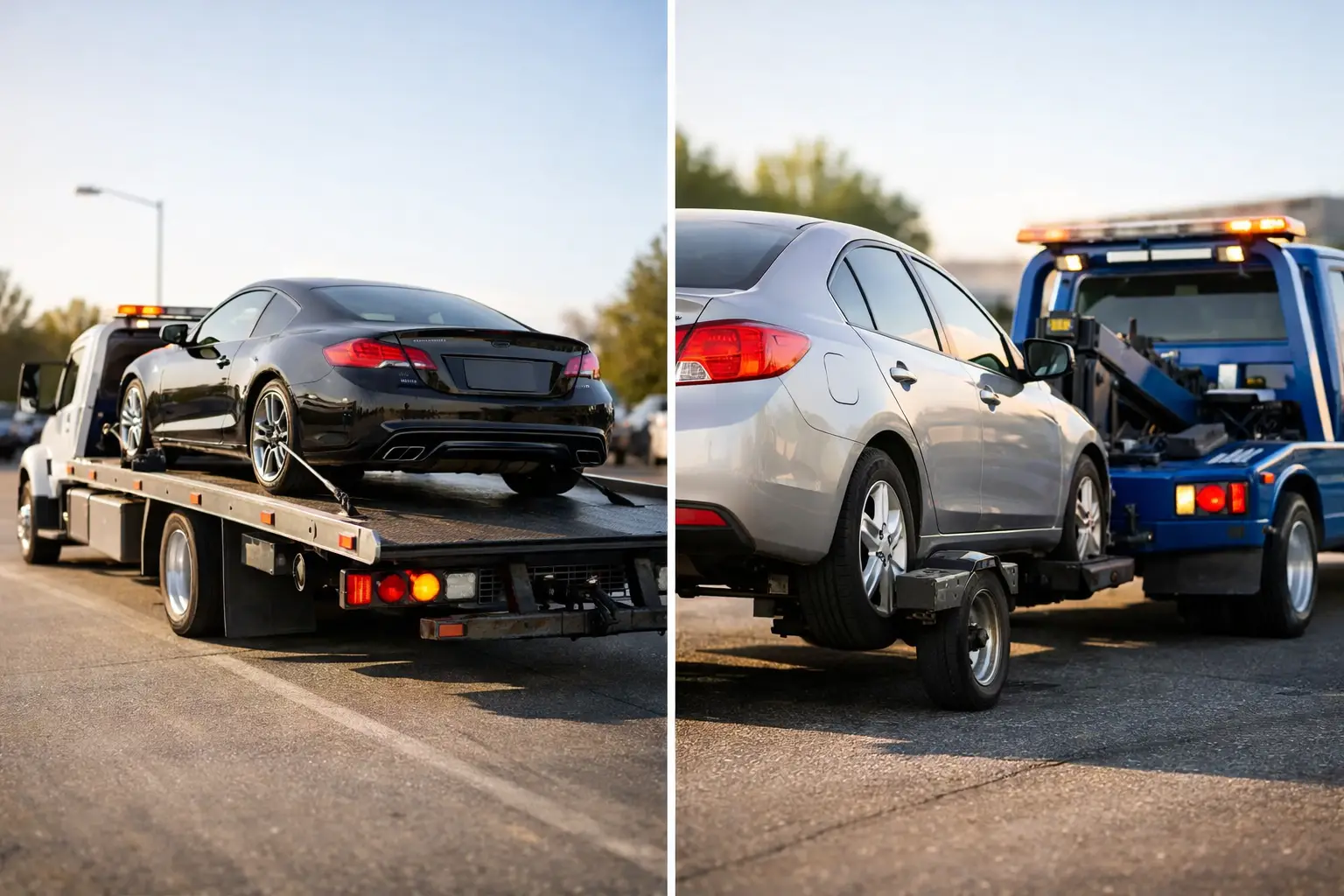
A flatbed tow truck carries the entire vehicle up onto a platform. Once loaded, all four wheels are off the ground. The vehicle rides fully supported until it reaches the destination.
A wheel lift tow truck uses a metal yoke to lift one end of the vehicle, usually the front or rear wheels, while the other two wheels remain on the road. This setup is common for shorter moves, tighter spaces, and situations where a fast hookup matters.
Both methods are widely used. Neither is automatically right or wrong. The question is which one best matches the vehicle and the roadside situation.
When flatbed towing is the better choice
Flatbed towing is often the safest option when a vehicle needs extra protection. Because the whole vehicle is off the road, there is less wear during transport and less risk of damage from dragging, road debris, or drivetrain movement.
This matters most for all-wheel drive vehicles, four-wheel drive vehicles, low-clearance cars, luxury vehicles, motorcycles, and cars that have suffered collision damage. If the suspension is broken, a wheel is damaged, or the car cannot roll normally, a flatbed usually gives the operator more control and gives the customer more peace of mind.
Flatbeds are also a strong choice for longer-distance towing. When the vehicle is secured on the bed, it stays stable and protected. If your car has already been through enough, such as a crash, a blown tire, or a major mechanical failure, a flatbed can reduce the chance of adding more problems on the way to the shop.
Why drivers often prefer flatbeds
Most customers feel more comfortable when they see their car fully loaded and strapped down. That is understandable. With all four wheels off the ground, there is less concern about tire wear, transmission issues, or whether a damaged axle will hold up during the trip.
That does not mean flatbeds are always necessary. It simply means they offer the broadest margin of safety for many vehicles.
When a wheel lift makes sense
Wheel lift towing has clear advantages too. It is efficient, practical, and often the best tool for straightforward towing jobs. If a standard front-wheel drive or rear-wheel drive vehicle is otherwise in stable condition, a wheel lift may be a perfectly safe option.
Wheel lift trucks are especially useful in parking garages, apartment complexes, narrow streets, and other tight areas where a flatbed may have trouble positioning. They can often hook up and move a vehicle more quickly, which matters when traffic is backing up or a disabled car is creating a hazard.
For shorter-distance tows, a wheel lift can be a smart and effective choice. It is also commonly used when the vehicle needs to be moved from one spot to another before being loaded differently or repaired.
Speed and access matter in real roadside calls
Not every breakdown happens in an open parking lot. Sometimes a car is stuck in a cramped driveway. Sometimes it is parked nose-in against a curb. Sometimes there is very little room to work safely.
That is where a wheel lift can be the better answer. A good operator chooses the equipment that can reach the vehicle, secure it properly, and get it out without creating more risk.
Which towing method is safer for your vehicle?
If you are asking strictly about maximum protection, flatbed towing usually has the edge. Keeping the entire vehicle off the road lowers the chance of wear and reduces complications for vehicles with drivetrain sensitivities.
But safety is not only about the truck type. It is also about the condition of the vehicle, the skill of the operator, and whether the correct procedure is used. A properly performed wheel lift tow can be completely safe for many vehicles. A flatbed is not automatically safer if the wrong loading angle is used on a low-clearance car or if the vehicle is not secured correctly.
The real answer is that the safest tow is the one matched to the situation.
Flatbed towing versus wheel lift for different vehicle types
Vehicle type makes a big difference in this decision.
For all-wheel drive vehicles, flatbed towing is usually preferred because all four wheels need to stay off the ground to avoid drivetrain damage. Many newer crossovers and SUVs fall into this category, so guessing is not a good idea.
For front-wheel drive or rear-wheel drive cars, wheel lift towing may work well if the correct end is lifted and the vehicle is otherwise in solid condition. Even then, the operator needs to assess tire condition, steering, brake status, and any visible damage.
For motorcycles, flatbed towing is generally the better option because the bike can be loaded and secured upright with the right equipment. For low-profile sports cars, flatbeds are also common because steep loading angles can be a concern and ground clearance is limited.
For accident-damaged vehicles, a flatbed is often the safer route. If parts are hanging loose, wheels are bent, or the car will not track straight, dragging two wheels down the road is usually not the right move.
Cost, speed, and convenience
Some drivers assume wheel lift towing is always cheaper and flatbed towing is always more expensive. Sometimes that is true, but not always. Pricing depends on distance, vehicle type, access, timing, and the complexity of the recovery.
What matters more is value. A lower-cost tow is not a bargain if it risks damage to the vehicle. On the other hand, requesting a flatbed for a simple short tow in a tight area may not be the fastest or most practical solution.
In urgent roadside situations, speed matters. So does getting the job done right the first time. The best towing companies look at both, then explain the choice in plain language.
How a professional decides on the right tow
A reliable tow operator does not treat every call the same. They consider the drivetrain, ride height, visible damage, wheel condition, location, and destination before deciding how to move the vehicle.
That is especially important after an accident or sudden breakdown, when customers may be shaken up and unsure what questions to ask. A good company keeps the process simple. They ask the right questions, send the right truck when possible, and avoid putting the customer in a position where they have to guess.
In areas like Gresham and Troutdale, where roadside conditions can range from busy traffic corridors to tight residential streets, that judgment matters. The best towing response is not just fast. It is appropriate to the vehicle and the scene.
What drivers should ask when they call
You do not need to know every towing detail, but a few simple questions can help. Tell the dispatcher what you drive, whether the vehicle was in an accident, whether it starts, and if any wheels are damaged or locked. Mention if the car is in a garage, in a narrow space, or sitting unusually low.
That information can help the towing company send the right equipment from the start. It also helps reduce delays, which is the last thing anyone wants when stranded.
If you are unsure whether your vehicle needs a flatbed, say so. A trustworthy local company will guide you without overcomplicating the situation. Tow Guys LLC handles these calls with that kind of practical, customer-first approach because people need answers they can use right away, not a lot of jargon.
The main thing to remember is simple. The best tow is not about choosing a truck type from a distance. It is about making sure your vehicle is moved the right way, by someone who knows what to look for, when the day has already gone sideways.
Need a tow in Gresham or East County? Call Tow Guys 24/7 at (971) 222-7994.