Flatbed Towing Versus Dolly Towing
When your car is disabled on the shoulder, the difference between flatbed towing versus dolly towing stops being a technical question and starts being a safety one. The right choice can protect your vehicle from added damage, make loading faster, and give you some peace of mind when the day has already gone sideways.
Most drivers do not think about towing methods until they need one fast. That is completely normal. In a breakdown, after a dead battery, engine trouble, or a collision, you are not comparing equipment specs. You want to know one thing - what is the safest way to move your vehicle right now?
What flatbed towing versus dolly towing really means
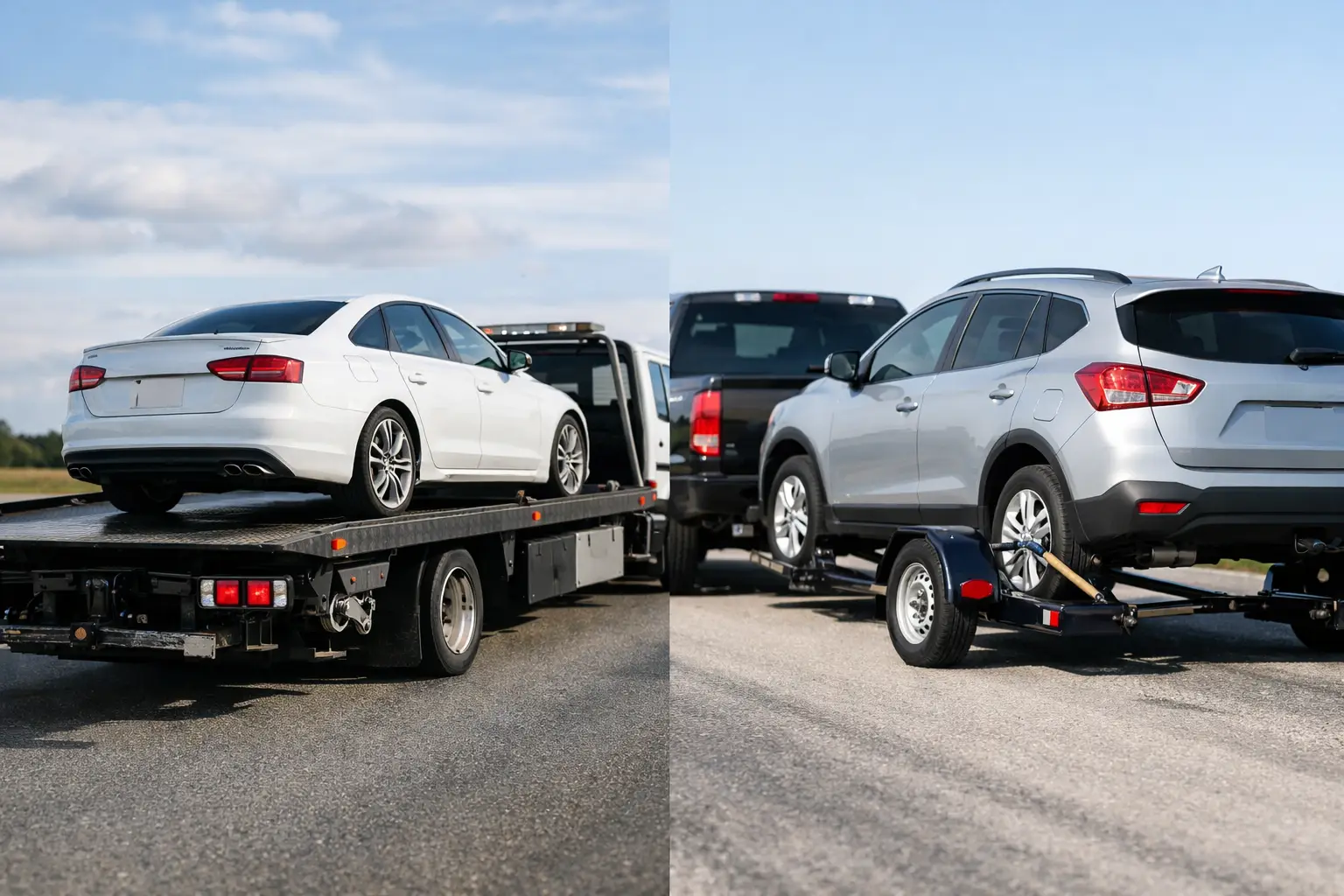
Flatbed towing places the entire vehicle on the back of a truck. All four wheels are off the ground during transport. The vehicle is secured in place and carried rather than rolled down the road.
Dolly towing lifts only one end of the vehicle, usually the front wheels, while the other two wheels stay on the road. This method can work well in the right situation, but it is more dependent on vehicle type, drivetrain, and condition.
That is why flatbed towing versus dolly towing is not just about cost or convenience. It is about matching the tow method to the vehicle and the reason it needs to be towed.
When flatbed towing is the better option
If a vehicle has major damage, flatbed towing is usually the safer call. The same goes for many all-wheel-drive vehicles, low-clearance cars, motorcycles, and vehicles with wheel or suspension problems. Since the whole vehicle rides on the truck, there is less chance of road contact causing more trouble.
Flatbeds are also a strong choice after an accident. If steering is compromised, a tire is shredded, or the axle is damaged, dragging two wheels on the road is often not a good idea. Loading the vehicle fully onto a flatbed reduces movement and gives the driver more control during transport.
For newer vehicles, specialty vehicles, or cars you simply want handled with extra care, flatbed towing often gives owners more confidence. It is the method many people prefer because it feels more secure, and in many cases, it is.
Why flatbeds reduce risk
With all four wheels off the pavement, there is less wear during transport. That matters for transmission protection, tire condition, and alignment. It also matters when a vehicle cannot roll freely or should not be pulled with part of its weight still moving down the road.
Flatbeds are especially useful when the vehicle will not start and cannot be shifted or steered normally. In those cases, the tow itself can become more complicated, and having the full vehicle on the truck simplifies the job.
When dolly towing makes sense
Dolly towing can be a practical solution for certain front-wheel-drive vehicles, especially when the vehicle is otherwise stable and the tow does not involve severe damage. By lifting the drive wheels off the ground, a tow dolly can move the vehicle efficiently without requiring a full flatbed in every case.
This method is often used when the vehicle is lighter, the damage is limited, and the drivetrain setup allows it. For some short-distance transports, it can be a reasonable and effective option.
That said, dolly towing is not universal. It has limits, and those limits matter. If the wrong type of vehicle is towed on a dolly, drivetrain damage can happen. That is why a professional tow operator will ask about the make, model, condition, and what happened before choosing the equipment.
Where dolly towing has trade-offs
The biggest trade-off is that two wheels remain on the road. That can be fine for some vehicles, but not for all. Rear-wheel-drive and all-wheel-drive vehicles need special attention, and some should not be towed this way at all without additional preparation.
Ground clearance can also be an issue. Very low vehicles may be harder to load safely onto a dolly. And if a vehicle has body damage, bent wheels, or suspension trouble, the setup may not be appropriate.
So while dolly towing can be useful, it depends much more on the exact vehicle and the exact problem.
Vehicle type matters more than most drivers realize
One of the most common mistakes people make is assuming every car can be towed the same way. That is not the case. Front-wheel-drive, rear-wheel-drive, all-wheel-drive, and four-wheel-drive systems all behave differently during towing.
A front-wheel-drive sedan with no major wheel damage may be a candidate for dolly towing. An all-wheel-drive SUV usually points the conversation toward a flatbed. A motorcycle should generally be transported with equipment designed for full support and secure tie-downs. A pickup truck with suspension damage may also need a flatbed, even if it looks towable at first glance.
This is one reason experienced operators matter. The safest tow is not based on guesswork. It is based on the vehicle's setup, its condition, and what will prevent further damage from the roadside to the destination.
Flatbed towing versus dolly towing after an accident
After a collision, flatbed towing is often the safer answer. Even if the damage looks minor, accident forces can affect parts you cannot easily see on the shoulder. Steering components, wheel alignment, brakes, tires, and suspension can all be compromised.
A dolly may still be possible in limited cases, but accident recovery is not the time to take chances. If the vehicle is leaking fluids, has broken body panels rubbing a tire, or will not track straight, keeping the entire vehicle off the road is usually the better move.
For drivers dealing with the stress of a crash, this matters because the goal is not just getting the vehicle moved. The goal is getting it moved without adding one more problem to the repair bill.
Cost matters, but damage costs more
Some people ask whether dolly towing is cheaper. Sometimes it can be, depending on the vehicle and the job. But price should not be the first factor if the method is wrong for the vehicle.
A less expensive tow can become very expensive if it causes drivetrain damage, tire wear, underbody scraping, or problems with alignment. In that sense, the better question is not which method costs less upfront. It is which method protects your vehicle best under the circumstances.
A trustworthy towing company will explain the recommendation in plain language. If a flatbed is needed, there should be a clear reason. If a dolly is safe and practical, that should be explained too. Good service means helping you understand the choice, not pushing equipment that does not fit the job.
What to expect when you call for a tow
If you need a tow, be ready to share the basics. The dispatcher or operator may ask what kind of vehicle you have, whether it starts, whether the wheels turn, and whether it was in an accident. They may also ask where it is located and whether it is in a tight spot like a parking garage, driveway, or narrow roadside shoulder.
Those questions are not there to slow things down. They help the company send the right truck the first time. In a place like Gresham or Troutdale, where weather, traffic, and road conditions can change quickly, getting the right setup on the way matters.
If you are not sure what is wrong with the vehicle, that is okay. Just describe what you see. Smoke, leaks, a flat tire, a broken wheel, or a car that will not shift out of park are all useful details.
So which towing method is best?
If your vehicle has major damage, all-wheel drive, low clearance, or any issue involving wheels, suspension, or steering, flatbed towing is usually the safer option. If you have a front-wheel-drive vehicle with limited damage and the setup is right, dolly towing may work just fine.
The key is not memorizing rules. It is having a trained tow operator make the call based on the real condition of the vehicle in front of them. That is how you avoid added damage and get the kind of help that actually lowers stress instead of adding to it.
When your vehicle is stranded, the best towing method is the one that gets you off the road safely, protects your car, and gives you one less thing to worry about.
Need a tow in Gresham or East County? Call Tow Guys 24/7 at (971) 222-7994.