
Can Towing Damage All-Wheel Drive Vehicles?
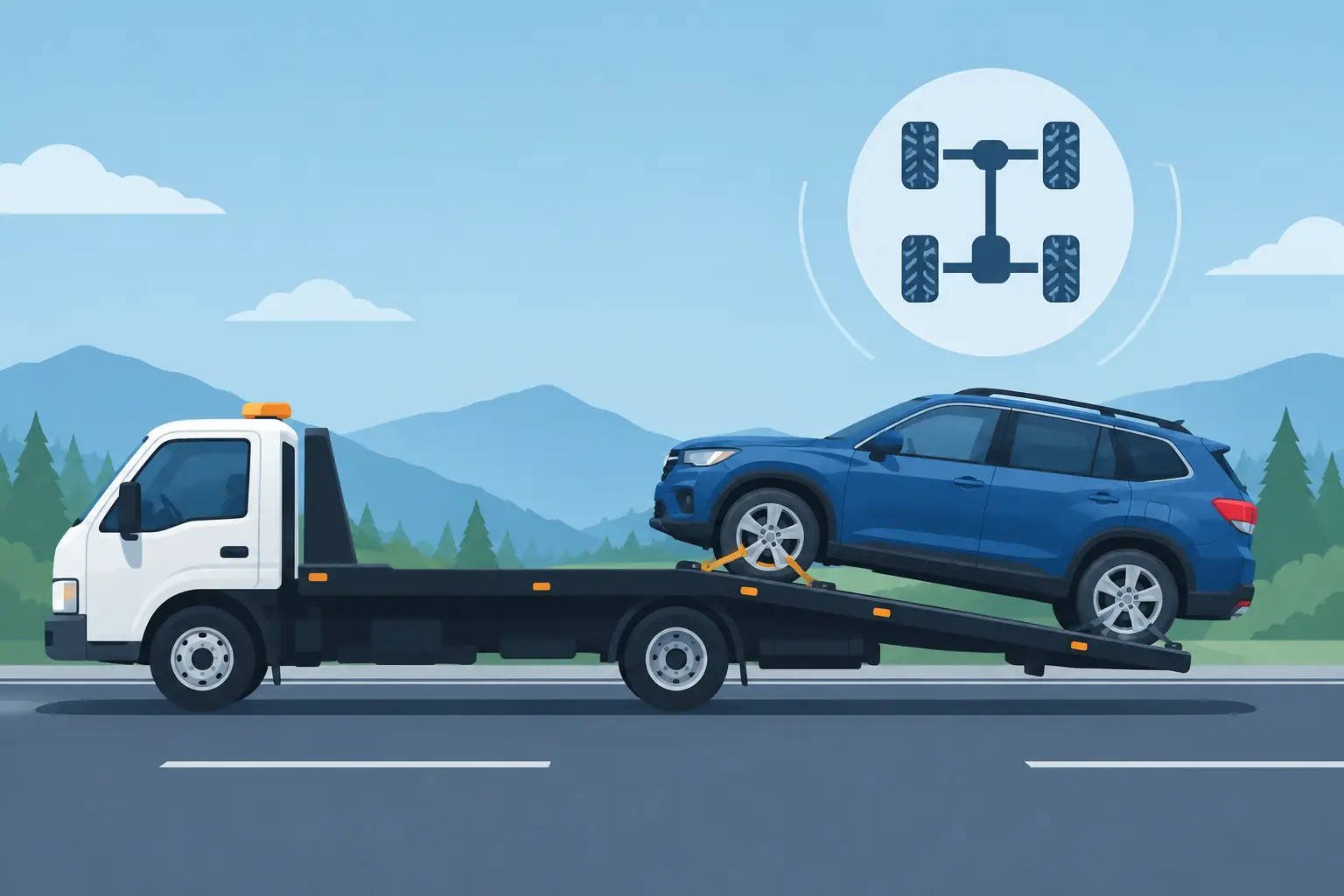
A breakdown is stressful enough without wondering whether the tow itself will create a bigger repair bill. So, can towing damage all-wheel drive vehicles? Yes. If an AWD vehicle is towed the wrong way, it can damage the drivetrain, including the transmission, transfer case, center differential, or electronic coupling. The good news is that proper equipment and the right towing method greatly reduce that risk.
For most AWD cars, SUVs, and light trucks, a flatbed tow truck is the safest answer. It keeps every tire off the road and prevents the drivetrain from being forced to turn when the engine is off. When you call for help, tell the dispatcher your vehicle is all-wheel drive before the truck arrives.
Why AWD Vehicles Need Special Towing Care
An all-wheel-drive system is designed to send power to all four wheels, either all the time or whenever the vehicle senses a loss of traction. That setup gives drivers extra confidence in rain, snow, gravel, and the changing road conditions around Gresham and Troutdale. It also means the front and rear wheels are connected through components that must rotate at compatible speeds.
When only two wheels are on the ground during a tow, those wheels turn while the other pair remains still. On many AWD vehicles, that difference can put strain on internal gears, clutches, shafts, and differentials. Since the engine is not running, some components may not receive the normal lubrication they need.
The damage may not always be obvious immediately. A vehicle might drive away from the tow seemingly fine, then develop whining noises, shuddering, warning lights, trouble shifting, or a burning smell later. Drivetrain repairs can be expensive, which is why the towing method matters from the first minute.
Can Towing Damage All-Wheel Drive on a Dolly?
A tow dolly lifts one axle while the other axle rolls on the pavement. It can be suitable for some front-wheel-drive vehicles, but it is usually not the right choice for an AWD vehicle.
If an AWD vehicle is loaded front wheels up, the rear wheels still turn. If it is loaded rear wheels up, the front wheels still turn. Depending on the design of the vehicle's drivetrain, either setup can make internal components rotate in ways the manufacturer does not allow.
There are exceptions. A small number of vehicles have a true neutral position in the transfer case, a manufacturer-approved driveline disconnect procedure, or specific instructions allowing two-wheel towing under limited conditions. But that is not something to guess about on the shoulder of the road. “Neutral” on the gear selector does not automatically mean the entire AWD system is disconnected.
Unless the owner's manual specifically approves dolly towing for your exact year, make, and model, request a flatbed. A professional towing operator can also use wheel dollies under the remaining tires when a flatbed is not possible because of tight access, crash damage, or a difficult recovery position.
The Safest Way to Tow an AWD Vehicle
A flatbed keeps all four tires stationary during transport. The vehicle is winched carefully onto the bed, secured at proper tie-down points, and carried rather than pulled along the road. That is the preferred method for most modern AWD vehicles, including those with automatic AWD systems and electronically controlled couplings.
Safe loading matters too. A tow operator should confirm whether the vehicle can be put in neutral, release the parking brake when appropriate, and avoid attaching recovery equipment to suspension parts, steering components, or body panels that are not rated as tow points. If the vehicle has collision damage, locked wheels, or a dead battery, the loading plan may need to change.
This is one reason a quick, low-cost tow can become costly if it is handled carelessly. The right truck alone is not enough. The driver needs to understand how to load and secure the vehicle without causing secondary damage.
What Can Go Wrong With an Improper Tow
The exact risk depends on the AWD system, but improper towing can affect several costly parts. A center differential may overheat or bind because the front and rear axles are rotating at different speeds. A transfer case can suffer internal gear or bearing damage. Vehicles that use clutch packs or electronic couplings may experience wear or failure in those parts.
Automatic transmissions are another concern. On some vehicles, internal lubrication is driven by the engine. Towing with the drive wheels rolling while the engine is off can leave moving parts without adequate fluid circulation. The longer and faster the vehicle is towed, the higher the potential risk.
Tires can also complicate the situation. AWD systems are sensitive to differences in tire circumference. If one tire is significantly more worn, underinflated, or a different size than the others, the drivetrain already has to compensate. Adding an improper two-wheel tow can create even more strain.
Do Not Rely on a Short-Distance Exception
Drivers sometimes hear that moving an AWD vehicle “just a few blocks” will be fine. That may be true for a particular vehicle under a particular manufacturer procedure, but it is not a safe general rule.
A short distance can still involve turns, uneven pavement, hills, and varying wheel speeds. More importantly, the person moving the vehicle may not know whether the system is full-time AWD, on-demand AWD, four-wheel drive, or a model with a special towing mode. Similar-looking vehicles can have very different rules.
If your car is disabled in a parking lot, driveway, or busy roadway, focus first on getting yourself to a safe location. Turn on hazard lights, move away from traffic if you can do so safely, and let the towing professional know that the vehicle is AWD. That simple detail helps ensure the right equipment is dispatched.
Check the Owner's Manual, But Do Not Delay Needed Help
Your owner's manual is the final authority for your vehicle. Look under sections labeled “Towing,” “Recreational Towing,” “Emergency Towing,” or “Transporting Your Vehicle.” The manual may specify flatbed transport only, identify approved tie-down points, or describe a limited procedure for towing with certain wheels off the ground.
Keep in mind that recreational towing behind an RV is different from emergency towing after a breakdown or accident. A vehicle approved for flat towing behind a motorhome may require detailed steps, special equipment, and exact transmission or transfer-case settings. It should never be assumed that those steps have been completed during an emergency roadside pickup.
If you cannot access the manual, do not take chances. Tell the towing company the year, make, model, and AWD or four-wheel-drive designation. A careful operator can verify the best approach before moving the vehicle.
What to Tell the Tow Company
Clear information helps prevent delays and protects your vehicle. When you call, share that it is AWD, where it is located, whether it has been in an accident, and whether the wheels can roll and steer. Mention if it is parked in a garage, has a flat tire, has a locked steering wheel, or will not shift into neutral.
These details help the operator arrive prepared. A vehicle that simply will not start may load differently than one with front-end damage or a wheel that is jammed after striking a curb. For urgent towing in the local area, Tow Guys LLC can assess the situation and use the equipment needed to move your vehicle safely.
The best time to protect an AWD drivetrain is before it moves. Ask for the appropriate towing method, keep all four wheels off the pavement whenever possible, and choose a towing team that treats your vehicle like it has to get your family home safely.
Need a tow in Gresham or East County? Call Tow Guys 24/7 at (971) 222-7994.